Your API, Cloud and Database Are Connected. What Happens When One of Them Turns Against You?
The modern attack surface isn't one system. It's everything connected to it.

Your Application Is Not Just an Application Anymore
Imagine you open a banking application and check your account balance. It looks simple from the user's perspective. You open the app, make a request, and receive your data.
Behind that request, however, several systems may be involved:
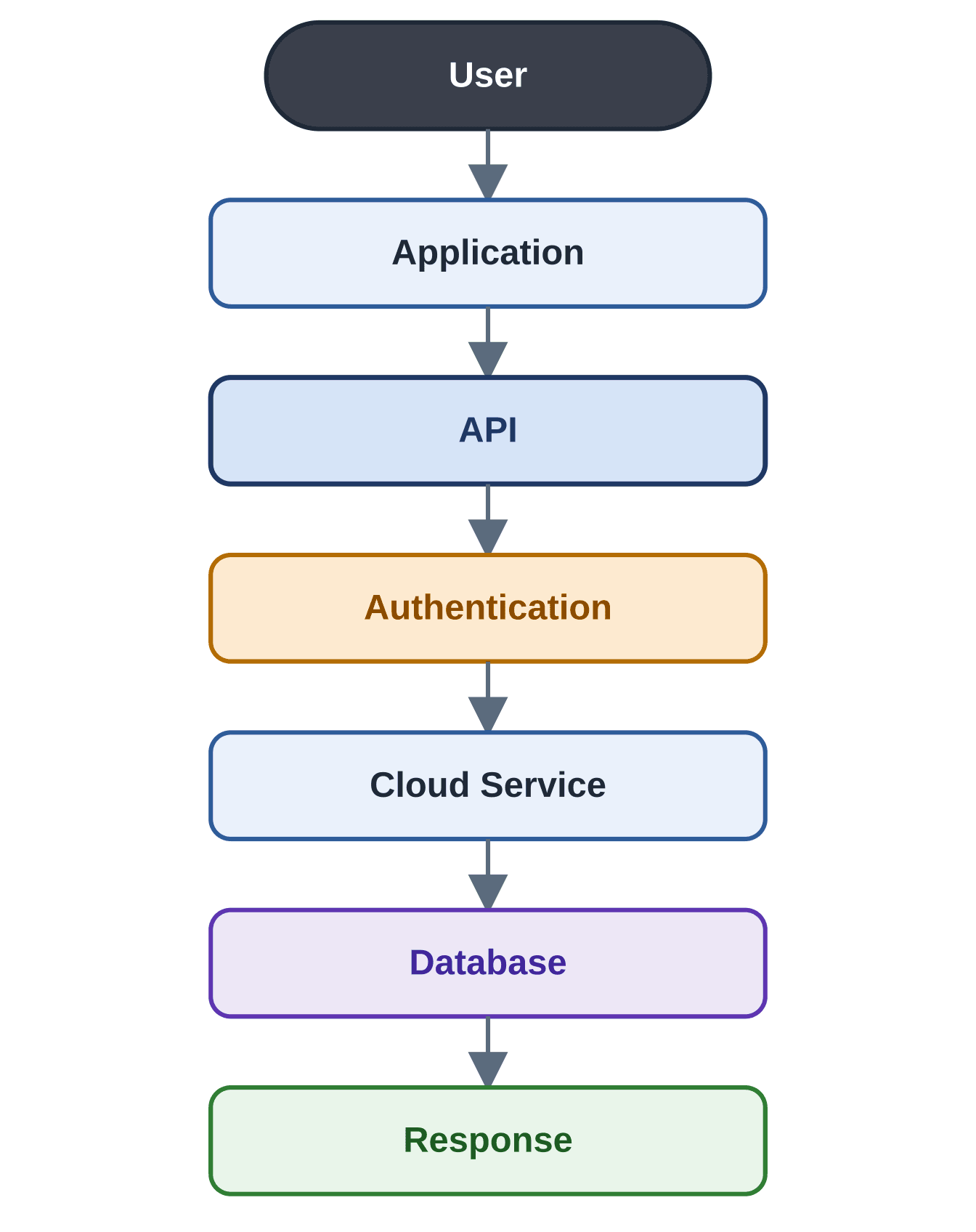
Each connection creates another place where security can fail.
The API could expose data it shouldn't. The authentication mechanism could be bypassed. A cloud service could be misconfigured. A database could be accessed through an overly powerful permission.
The application may appear secure from the outside while one of its connected components quietly creates the real vulnerability.
The API Is a Door to Everything Behind It
APIs are designed to connect systems. That is exactly what makes them powerful - and dangerous.
Consider an API request such as:
API request
GET /users/1042The API receives an object ID and returns information about that user.
Security check
“Is the person making the request actually allowed to access user 1042?”
Security risk
If the API checks only whether the user is logged in, but does not verify whether they are authorized to access that particular object, an attacker may simply change the ID.
Object ID changed
/user/1042 → /user/1043 → /user/1044
This is Broken Object Level Authorization (BOLA) (opens in a new tab), one of the major risks identified by the OWASP API Security Top 10. (opens in a new tab)
Authentication
Authentication answers:
“Who are you?”
Authorization
Authorization must also answer:
“What are you allowed to access?”
Sometimes the Problem Is What the API Returns
Authorization problems don't stop at the object level.
Imagine an API returns:
{
  "name": "John",
  "email": "john@example.com",
  "role": "customer",
  "internal_notes": "...",
  "account_balance": 50000
}
The application may only need the user's name and email.
If the API exposes additional sensitive fields simply because they exist in the underlying object, the API is revealing more than the client actually needs. The opposite problem can also occur.
An attacker may try to modify properties they should never be allowed to change:
role = "admin"
account_status = "approved"
This is why object property-level authorization matters. Security isn't only about protecting the endpoint. It is also about controlling which data and properties the endpoint exposes or accepts.
One API Can Affect More Than Security
APIs don't only expose data. They can trigger actions.
Consider an API for:
- purchasing tickets,
- sending SMS messages,
- generating reports,
- creating accounts,
- processing payments,
- uploading files.
If an attacker can repeatedly automate one of these operations, the result may not be a traditional data breach.
It could become:
“resource exhaustion, financial loss, service disruption, or business abuse.”
Open Web Application Security Project (OWASP (opens in a new tab)) calls this Unrestricted Resource Consumption (opens in a new tab) and Unrestricted Access to Sensitive Business Flows (opens in a new tab). The vulnerability isn't always a missing line of code. Sometimes the problem is that the business operation itself was never designed to handle uncontrolled automation.
The API Can Also Become a Bridge into the Internal Network
Now consider an API that accepts a URL and asks the server to retrieve it.
For example:
“API → "Fetch this URL" → User-controlled destination”
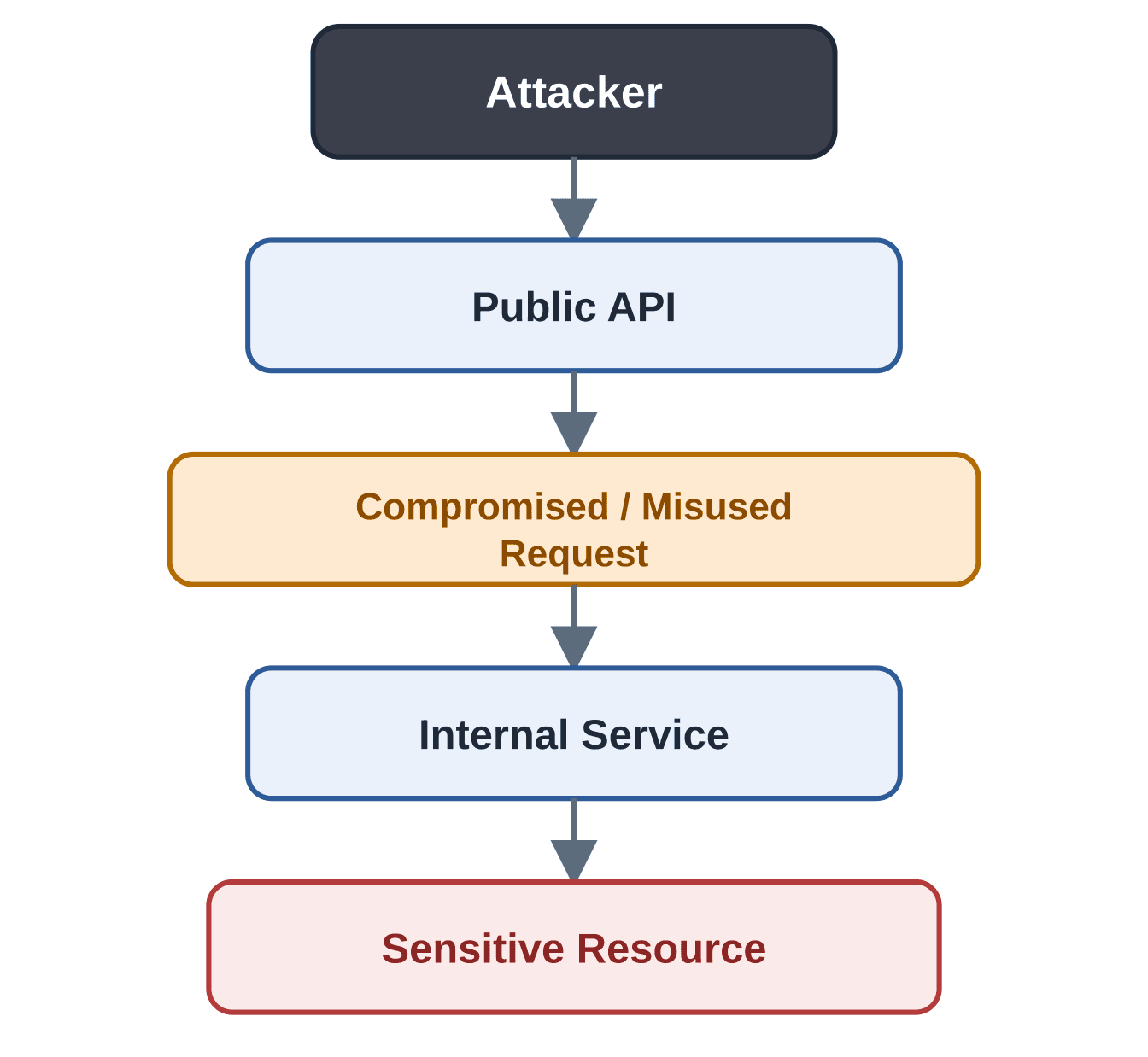
If that destination is not properly validated, an attacker may attempt to make the server send requests to internal resources that the attacker cannot directly reach.
This is Server-Side Request Forgery (SSRF). (opens in a new tab) The important idea is that the attacker doesn't necessarily need direct access to the internal system. They may convince another trusted component to access it for them.
The Problem Gets Bigger in the Cloud
Modern applications rarely depend on one API or one server.
They may use:
“APIs + cloud services + databases + containers + third-party services + internal microservices.”
That creates a chain of dependencies. If one component is poorly protected, the attacker may use it to reach another component.
“Internet → API → Cloud Service → Internal Service → Database”
The security of the entire system therefore depends on more than securing each component individually. We also need to understand how those components are connected and what each connection is allowed to do.
This Is Where Zero Trust Connects
This is closely related to the idea from the “previous blog”.
A modern API shouldn't automatically trust another service just because it exists inside the same environment. Instead, access should be based on identity, permissions, context and least privilege.
For example:
“Service A → Request → Identity Check → Permission Check → Policy → Specific API / Resource”
This limits what a compromised service or stolen credential can access. The objective isn't simply to prevent every attack. It is to reduce how far an attack can travel.
And APIs Need to Be Known Before They Can Be Protected
There is another surprisingly common problem: organizations don't always know exactly which APIs they have. Applications evolve but the old versions remain online. Development endpoints accidentally reach production. Debug interfaces are forgotten. Third-party APIs are added without proper security review.
An organization might think it has:
“API v2”
while an older:
“API v1”
is still accessible somewhere.
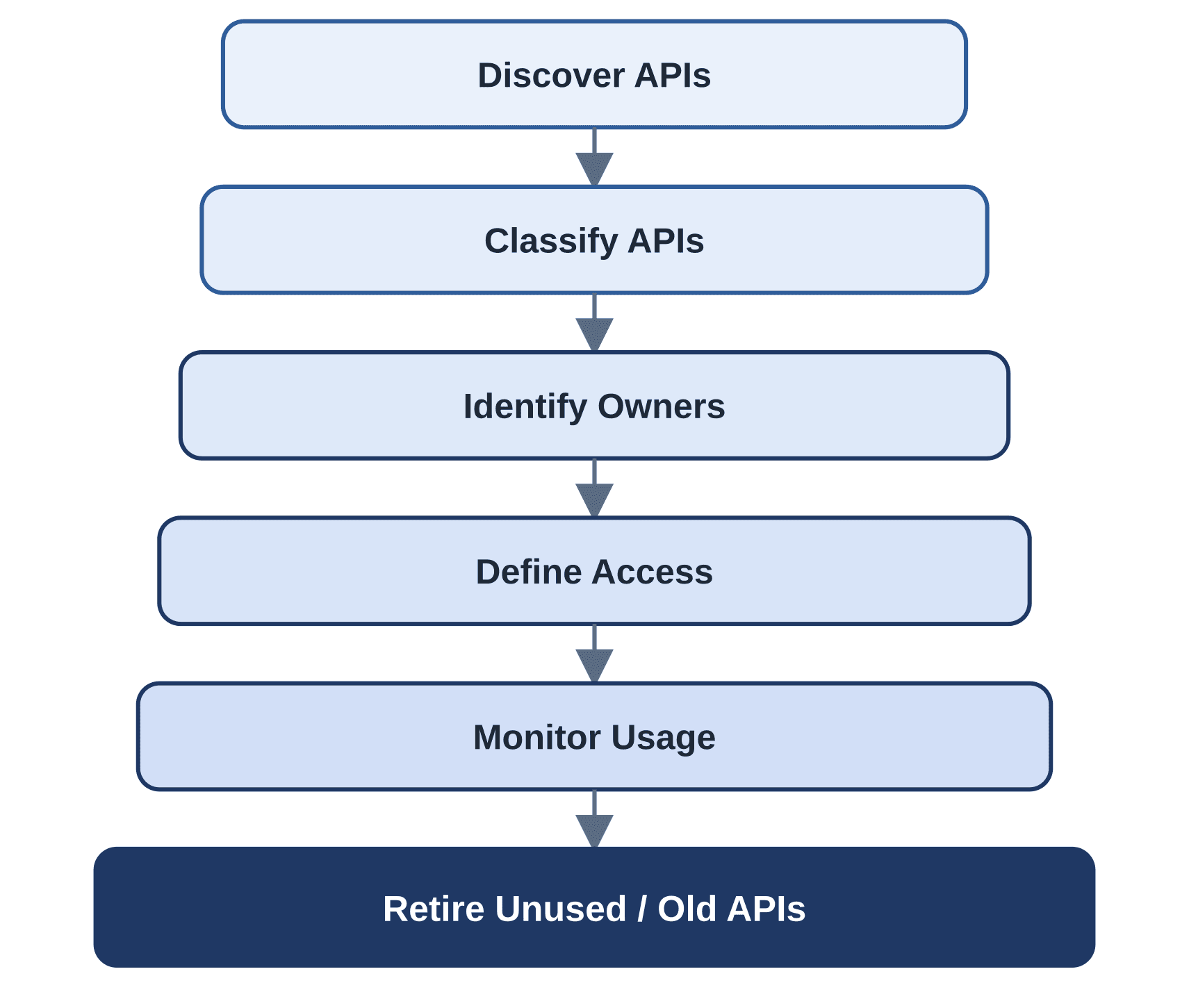
OWASP identifies this as Improper Inventory Management (opens in a new tab). You cannot properly secure an endpoint you don't know exists. A useful security process therefore starts with:
What About AI Agents and Their APIs?
This becomes even more interesting when AI agents enter the architecture. An AI agent may not only consume an API. It may decide when to call it and what parameters to send.
For example:
“User Request → AI Agent → Decides Which Tool to Use → API Call → Business System”
Now API security and AI security overlap.
The question becomes:
“Should the agent have access to this API at all?”
And if it does:
“Which operations should it be allowed to perform?”
How ART Approaches API Access
This is an area where A Realtime Tech (ART) provides a useful real-world example. ART's platform connects AI agents, workflows, APIs, tools and business systems, while providing mechanisms for controlled access and governance.
Instead of treating every API as having the same level of exposure, APIs can be exposed according to their intended use and access requirements - including global, private and specific API types. This allows an architecture to distinguish between APIs that are broadly reusable and APIs that should remain restricted to particular applications, workflows or contexts.
A simplified model looks like:
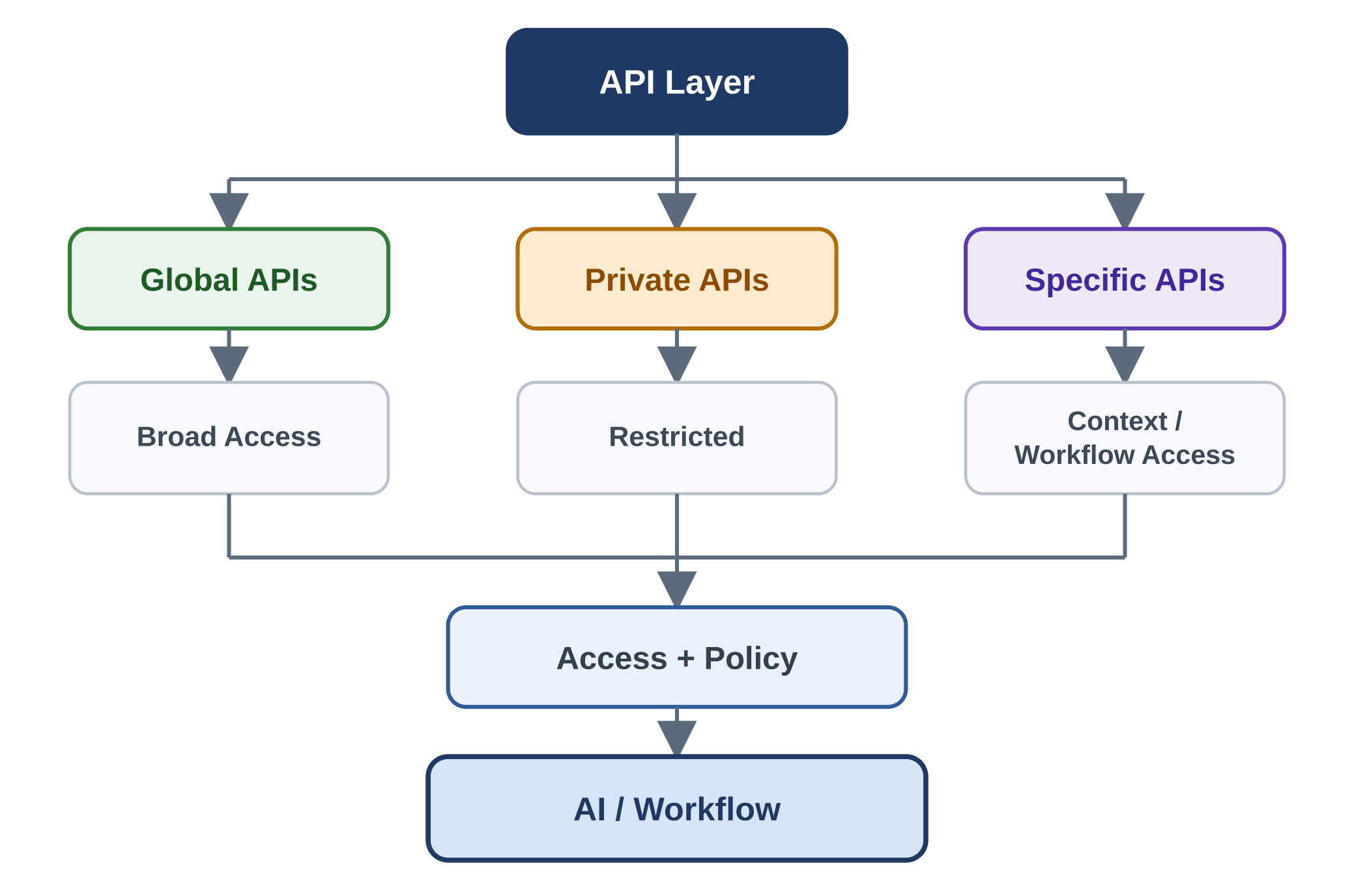
This becomes especially useful when AI agents and workflows are interacting with enterprise systems. The goal is not simply to connect everything, but to make those connections intentional, scoped and observable.
You can explore ART's platform and its API, agent and workflow capabilities here: A Realtime Tech (opens in a new tab)
The Real Attack Surface Is the Connection
An API by itself isn't necessarily dangerous. A database by itself isn't necessarily dangerous. A cloud service isn't necessarily dangerous. The risk often appears in the connection between them.
An API with excessive permissions can expose a database. A compromised credential can unlock a cloud service. A forgotten endpoint can expose an old application. A vulnerable third-party integration can become a path into your environment.
And an AI agent with excessive API permissions can potentially turn a simple instruction into a real-world action. That is why modern security has to look beyond individual components. It has to understand relationships, permissions and the actions those relationships enable.
Conclusion
Modern applications are built from interconnected systems, and that connectivity creates a much larger attack surface than the traditional network perimeter suggests. APIs can expose data, trigger sensitive business operations and even become bridges into internal resources when authorization or validation fails. Cloud services, databases, microservices and third-party integrations add further dependencies that attackers can exploit. As AI agents gain the ability to call APIs and perform actions, controlling those connections becomes even more important.
The question is no longer simply whether each component is secure - it is whether the connections between them are secure.
Sources and further reading
- OWASP API Security Top 10 - 2023 - OWASP API Security Top 10 (opens in a new tab)
- NIST Special Publication 800-207A - A Zero Trust Architecture Model for Access Control in Cloud-Native Applications - NIST SP 800-207A
- NIST Cybersecurity Framework (CSF) 2.0 - NIST CSF 2.0 (opens in a new tab)
- A Realtime Tech (ART) - ART (opens in a new tab)
About the Author

Adithya Sapalya
AI Engineer
An AI Engineer who combines AIML engineering, GenAI, and cybersecurity to build practical agentic systems and intelligent automation that turn complex ideas into real-world solutions.
View on LinkedIn (Adithya Sapalya, opens in a new tab)Further Reading

The Hacker Doesn't Need to Break the Door Anymore - So What Are They Attacking?
How cloud-native systems are changing the attack surface

Your Firewall Is Working. But Is Your System Actually Secure?
Why modern cybersecurity is moving beyond the network perimeter